

eng
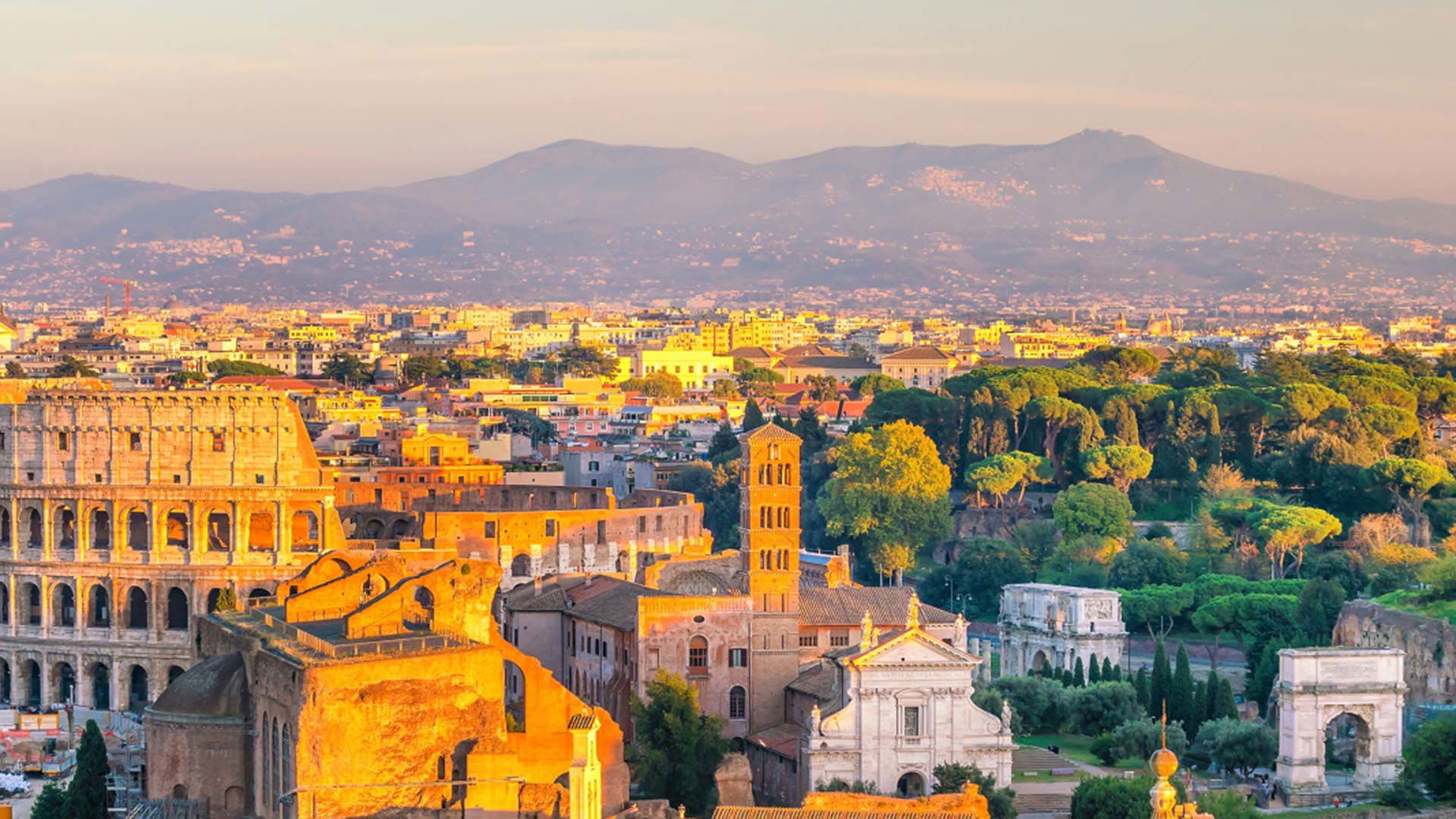
The Aventine is one of the seven legendary hills on which Rome was founded, a slope-steep hill that almost touches the Tiber River. It lies south of the Circus Maximus and east of the river. In the Savello Park—better known as the Orange Garden—you can reach a refined and charming terrace overlooking the Tiber, offering a sweeping view of Rome’s domes, with St. Peter’s Basilica standing prominently above them all. From this spot, one of the most beloved and visited in the city, the view is spectacular at any time of day or night.
The Aventine Hill is an elegant, peaceful residential area and one of the most cherished viewpoints of the Eternal City. The Orange Garden, created by Raffaele de Vico in 1932, stands beside the belvedere of the Garden of Sant’Alessio. Dotted with flourishing orange trees, the garden was once the place where Saint Dominic, founder of the Dominican Order, preached. Through a small hole in the wall of the nearby church of Santa Sabina, you can still see the orange tree associated with his preaching.
The garden is arranged symmetrically: once past the entrance gate, a central avenue leads visitors toward the panoramic terrace. On either side, two open spaces frame the walkway; yet the beauty reveals itself immediately—even before approaching the parapet—as the silhouettes of the monuments emerge, composing a striking skyline.
At sunset, the atmosphere becomes enchanting; the light warms the contours of the city, and everything takes on a romantic glow. Lovers exchange tender looks, and even those visiting alone can’t help but fall in love with Rome.
The imposing Basilica of Santa Sabina becomes visible through the outlines of its dark windows, which softly illuminate the interior. Built under the pontificate of Celestine I (422–432) by Peter of Illyria, it is a remarkable example of an early Christian basilica with a longitudinal plan.
Inside, a wide space opens up, marked by two rows of twelve marble columns. The interior is simple and austere; from the original decoration remain the mosaic above the main door, the marble inlays crowning the colonnade, and fragments of stucco and frescoes in the side aisles.
Before the curve of the apse stands the schola cantorum, decorated with branches, birds, spheres, and stars—motifs revealing an Iranian origin inspired by cosmogonic symbolism. In the apse conch, the fresco by Taddeo Zuccari depicts Christ on the mount, surrounded by Saints and Apostles.