

eng
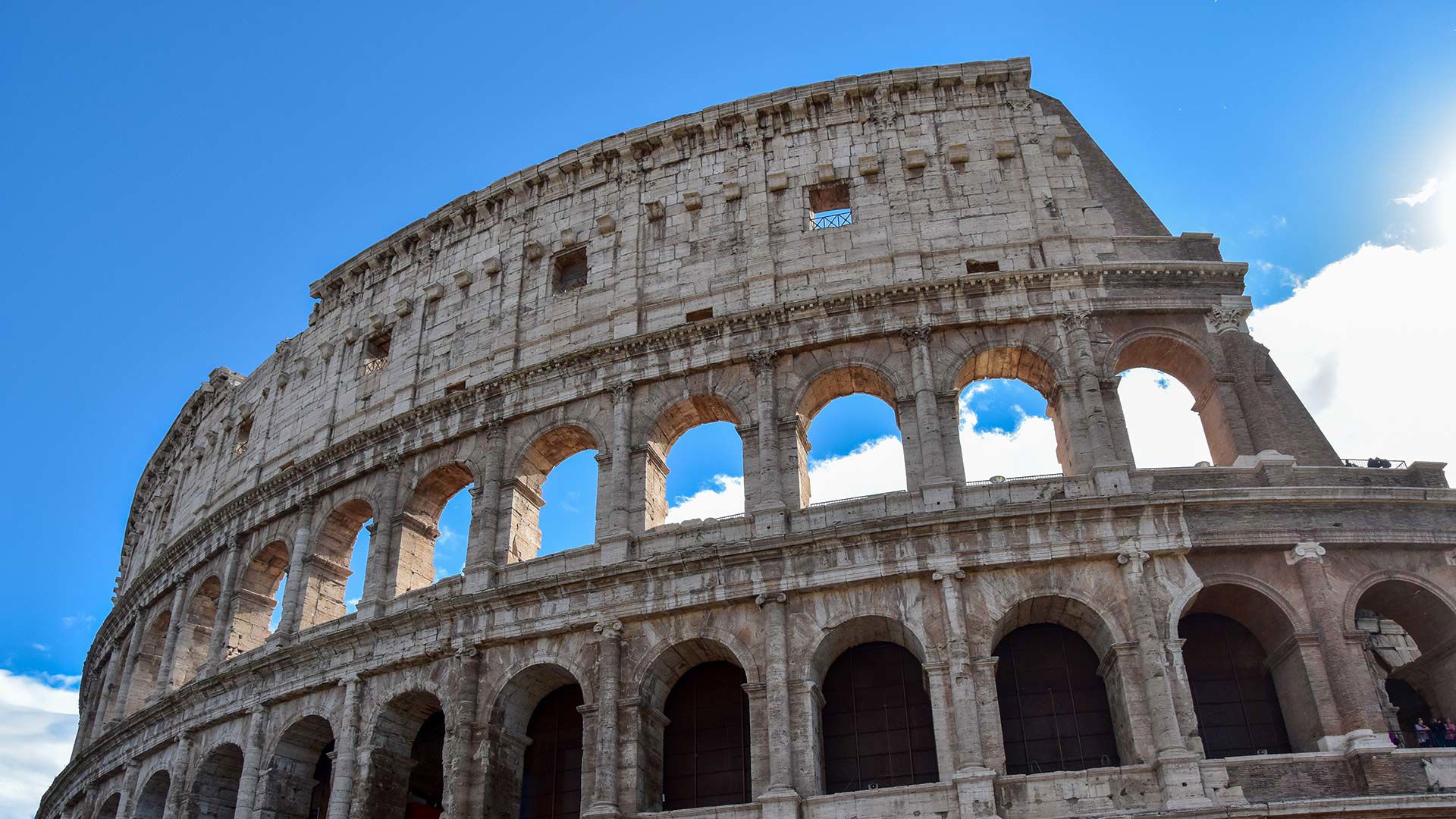
The most imposing monument that bears witness to ancient Rome is the Colosseum, or Flavian Amphitheatre. Next to it stand the Arch of Constantine and the Domus Aurea, Nero’s luxurious residence. To prepare the area for the Colosseum, the artificial lake surrounding Nero’s villa was drained. Vespasian ordered the construction in 72 AD, using brick, tuff, and travertine quarried near Tivoli. From 80 AD onward, the amphitheatre remained active for about four hundred years.
The Colosseum has always been an outstanding example of architecture: a system of corridors directed the flow of spectators—around 50,000 people—who sat on the tiers according to their social rank. From their seats they watched gladiatorial combats, target-shooting exhibitions, and the executions of those condemned to be torn apart by wild beasts. Seen from above, the building appears as a large arena with three levels, each featuring 80 arches.
Descending into the underground area, one finds tunnels, cells, and passageways through which animals, gladiators, and prisoners destined for the games once moved. Behind the Colosseum rises the Arch of Constantine, inaugurated in 315 AD to celebrate the emperor’s victory over Maxentius at the Battle of the Milvian Bridge in 312. The arch was decorated with reliefs taken from various monuments, including works dedicated to Trajan, Marcus Aurelius, and Hadrian. The sculptures depicting the phases of the battle belong to the Constantinian period.
From Piazza del Campidoglio, a staircase leads to the Mamertine Prison, where war prisoners were held and where, according to tradition, Saint Peter himself was confined. Opposite stands the complex of Saints Martina and Luke; following Via Tulliano you reach Via dei Fori Imperiali, built by Mussolini to glorify the triumphs of Rome. On the Romulus and Remus square is the entrance to the Roman Forum. In ancient times the area was a swamp that was later drained.
The Forum became the center of political, religious, and commercial life in the Roman Empire. Its main road is the Via Sacra, used for sacred processions and triumphal parades, lined with temples and sanctuaries. Many temples can be seen along the route; among the most important is the Temple of Saturn, one of the oldest in Rome, where the State treasury was kept. Each year the Saturnalia, celebrations in honor of the god Saturn, took place here.
The Temple of Vespasian was built by Domitian; today only three Corinthian columns remain. One of the most remarkable monuments is the Temple of the Dioscuri, or of Castor and Pollux. It was erected by the dictator Aulus Postumius who, according to legend, wished to honor the twin sons of Jupiter, said to have appeared to the Romans during a battle and helped them defeat the Latins and the Tarquins. Rebuilt several times, the temple is now represented by three magnificent Corinthian columns. For a long period, the area was used by bankers.
On the opposite side of the Via Sacra are the Temple of Vesta and the House of the Vestal Virgins. The cult of Vesta was one of the most ancient in Rome: the priestesses, chosen as young virgins, had to keep the sacred fire constantly lit and abide by a vow of chastity. Those who broke it were punished severely and sometimes buried alive. The Vestals lived in their residence until the age of thirty. Also located on the Via Sacra is the Temple of Antoninus and Faustina, built in 141 AD by Emperor Antoninus Pius in memory of his wife. After his death, the temple was dedicated to both of them. Many other temples accompany visitors throughout the Forum.
Political life took place in the Curia, the seat of the Senate. The building was restored several times and was finally rebuilt in the 3rd century by Diocletian. In front of the Curia stands the Comitium, the area used for public assemblies.