

eng
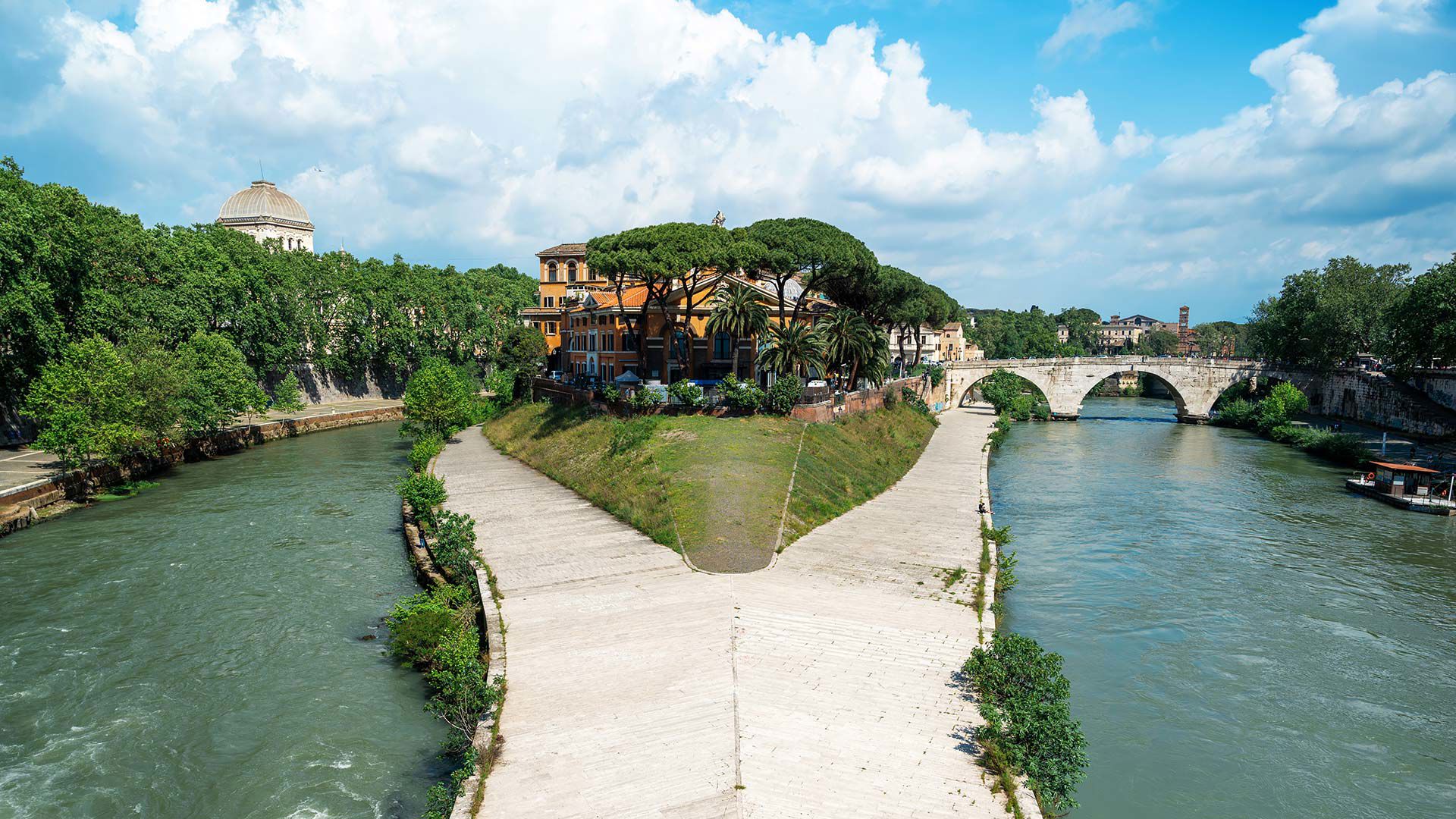
Tiber Island is connected to Trastevere by the Cestius Bridge and to the former Jewish Ghetto by the Fabricius Bridge, also known as the “Broken Bridge.”
Its elongated shape resembles that of a ship, and the travertine structures at both ends were compared to the bow and stern. In ancient times, the island housed a temple dedicated to Aesculapius, the god of medicine and protector against the plague. Continuing this tradition, the Fatebenefratelli Hospital now stands here. On the ruins of the ancient temple, the Church of San Bartolomeo all’Isola was built; located in the island’s central square, it was modified several times until it took on its current Baroque appearance in the 17th century.
Crossing the Fabricius Bridge—the only ancient Roman bridge to survive almost intact and still in use—one reaches the former Jewish Ghetto. The Jews, originally settled in Trastevere, were esteemed during the Empire for their skills in medicine and finance.
It was Pope Paolo IV who decreed that Jews had to live in a confined, walled area reserved solely for them. The wall stretched from the Fabricius Bridge to the Portico of Octavia and the Piazza delle Cinque Scole. Thus the ghetto was born. Its inhabitants were allowed to leave during the day but not at night, when the gates were locked; they were also forced to attend Christian sermons in the Church of Sant’Angelo in Pescheria. Under Fascism, persecution resumed, leading to mass deportations to concentration camps.
Only in 1848, under Pope Pio IX, were the walls demolished, and forty years later the neighborhood was leveled and rebuilt around the synagogue, completed in 1904. Even today, many ghetto residents are Jews who maintain a deep connection to their traditions, history, and business activities.
Inside the synagogue, visitors can explore the Permanent Exhibition of the Jewish Community of Rome, now the Jewish Museum, which preserves original manuscripts, prayer books, sacred furnishings, and historical documents relating to the former ghetto.
Next to the synagogue stands Palazzo Cenci, once owned by the Cenci family, known for the tragic story of Beatrice Cenci, accused of witchcraft and of murdering her father at the instigation of her stepmother and brother. All were condemned and executed at Ponte Sant’Angelo.
A short walk away is the Portico of Octavia, built by Augustus in honor of his sister Octavia and the only surviving structure of the monumental square of the Circus Flaminius. It marked the area of the temples of Jupiter and Juno and was restored under Caracalla. Part of the ancient entrance now serves as access to the Church of Sant’Angelo in Pescheria, named after the fish market that once operated on the ruins thanks to the nearby river port.
The ghetto ends at Piazza Mattei, named after the noble Mattei family, where the charming Turtle Fountain stands, designed by Giacomo della Porta and sculpted by Taddeo Landini.
Continuing along Via di Torre Argentina, one reaches Largo di Torre Argentina, dominated by the excavations of the “Sacred Area.”
In the 1920s, the remains of four Republican temples—the oldest found in Rome—were uncovered here. Since their dedicatory deities could not be identified, they are referred to as A, B, C, and D. Adjacent to the site is the Teatro Argentina, founded by the Sforza family and still one of Rome’s most prestigious theatres.