

eng
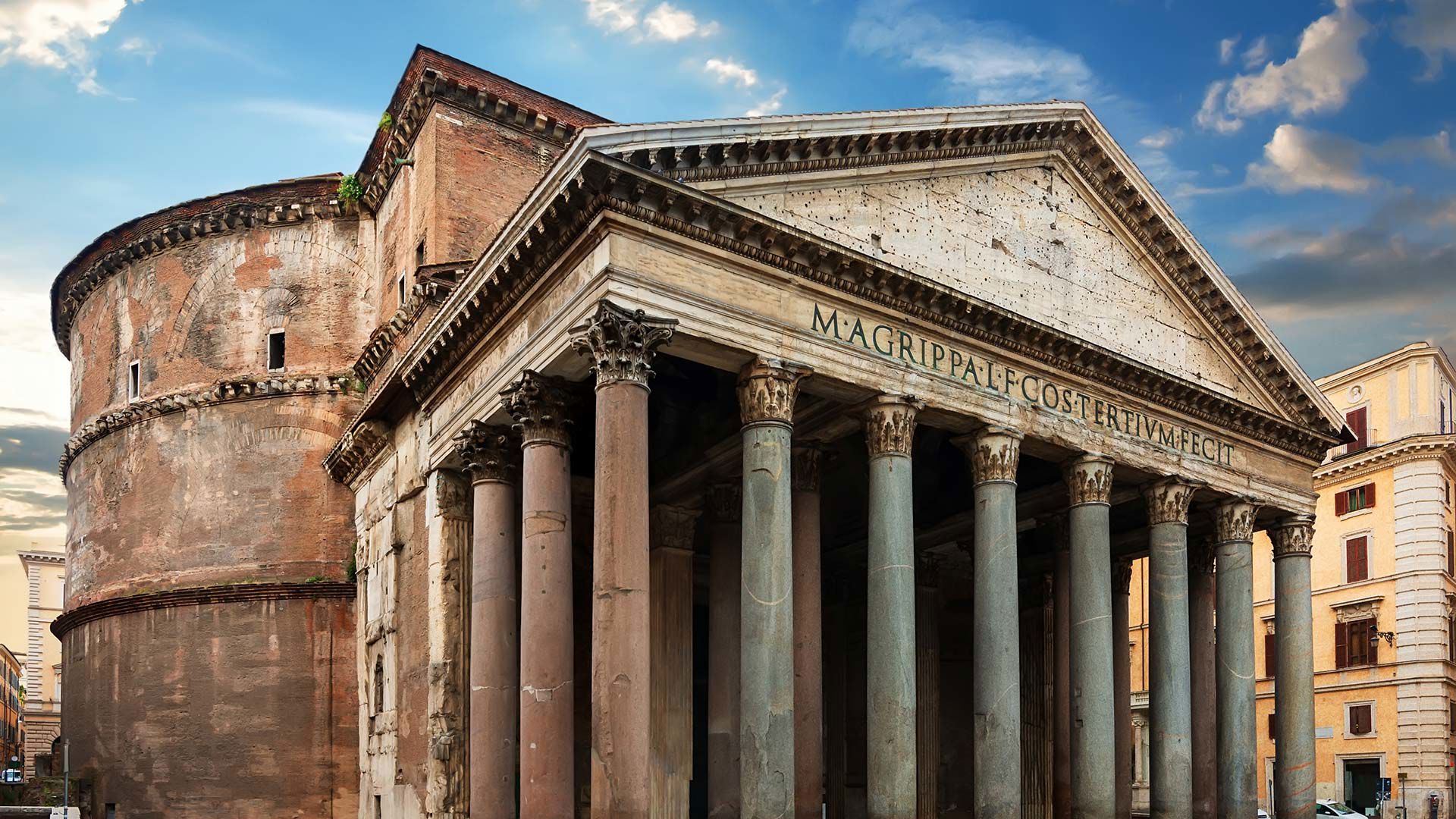
From Via del Corso, through a maze of narrow alleys, you reach the heart of ancient Campus Martius, arriving in Piazza della Rotonda. Here, in front of a 16th-century fountain crowned with an Egyptian obelisk, stands the Pantheon, which has dominated the square for nearly two thousand years.
It is the best-preserved and most frequently imitated Roman monument, and the only one to have maintained its original religious function throughout the centuries. Emperor Hadrian had it built to replace the earlier temple of Marcus Agrippa—Augustus’s son-in-law and architect—which had been repeatedly destroyed by fire. In the Middle Ages, this temple dedicated to all the gods was converted into a Christian church.
The building has a circular floor plan and is marked by an enormous dome, striking for its size (43.3 meters in diameter), with a central oculus that serves as the only source of daylight and was likely used for astronomical observations. Inside are the tombs of Raphael and several kings of Italy. Surrounding the Pantheon is the area of Santa Maria sopra Minerva and the square of the same name. At its center stands the famous “Pulcin della Minerva,” the small elephant carrying an obelisk, designed by Gian Lorenzo Bernini. On the right side of the church façade—so named because it was built atop the ruins of a temple dedicated to Minerva—several plaques mark the height reached by the Tiber’s floods over the centuries.
Continuing the walk, past Piazza Sant’Eustachio—a well-known meeting point—and Corso Madama, you reach the spectacular Piazza Navona, pleasantly removed from heavy traffic.
The elongated shape of the square recalls the stadium that Emperor Domitian built here for musical performances and poetry competitions. The buildings surrounding the square were constructed over the ancient tiers of seating. This magnificent Baroque setting owes much of its splendor to the powerful Pamphili family, who commissioned not only a grand palace and the Church of Sant’Agnese, but also three monumental fountains.
At the center stands the celebrated Fountain of the Four Rivers, created by Bernini—though the commission was initially intended for Borromini—which symbolizes the great rivers of the four known continents: the Ganges, the Danube, the Río de la Plata, and the Nile. Completing the ensemble are the Fountain of the Moor, sculpted from a model by Bernini, and the Fountain of Neptune by Della Porta.
Until the late 19th century, Piazza Navona was intentionally flooded in August by blocking the fountain drains, providing entertainment for nobles who raced through the water sprays with their carriages. Today, the square is lively throughout the year and becomes especially popular in winter during the Epiphany celebrations, when numerous toy stalls attract both children and adults.
Overlooking the Fountain of the Four Rivers is the Church of Sant’Agnese in Agone, designed and almost entirely executed by Francesco Borromini. The church stands on the spot where, according to tradition, the saint was exposed naked to public humiliation and miraculously covered by her long hair. In the basement, remnants of Domitian’s ancient stadium can still be seen.