

eng
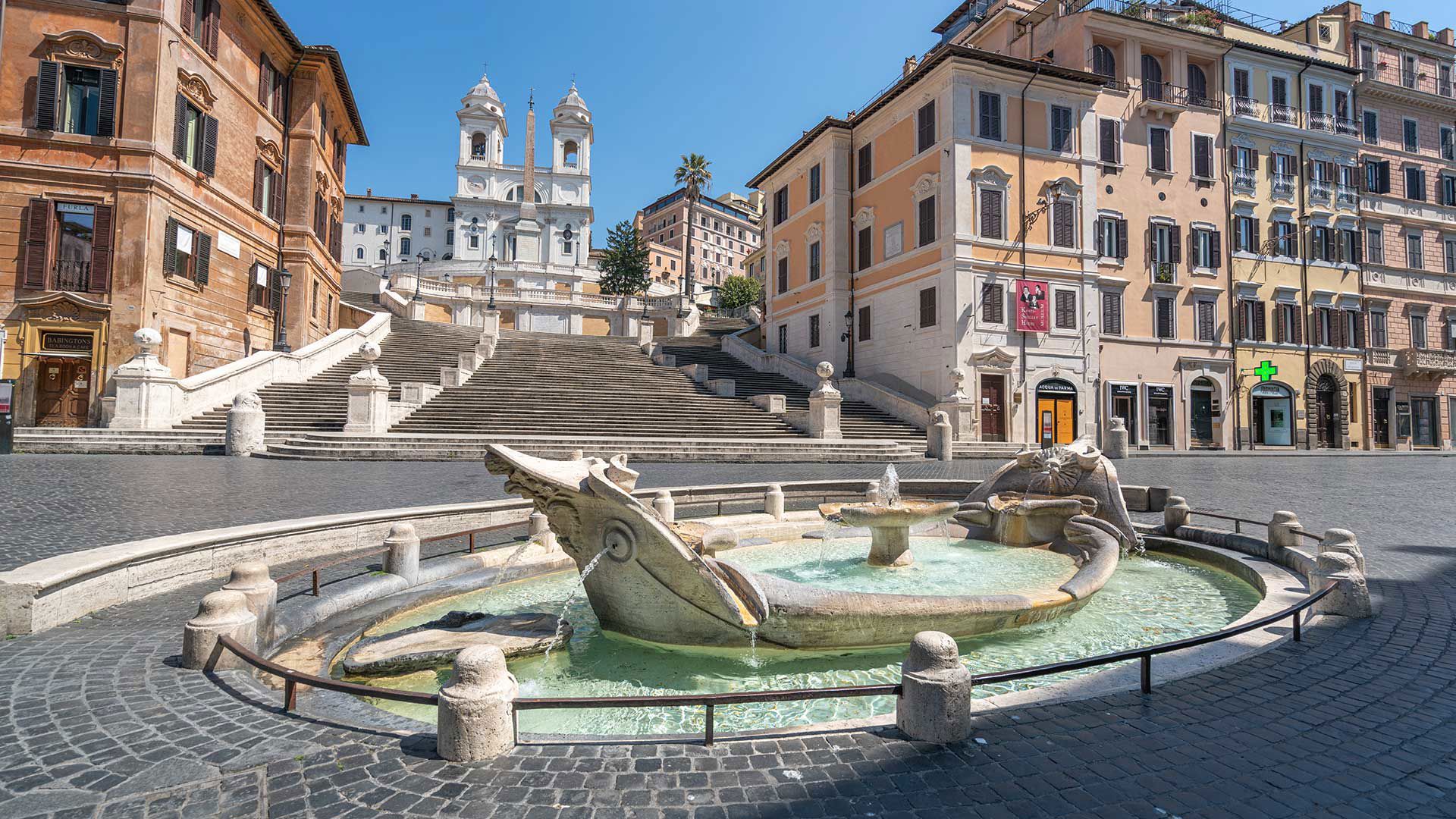
From Piazza Barberini, you continue along Via Sistina, an elegant street lined with shops and home to the theater of the same name. Soon you reach one of the most beautiful and characteristic areas of Rome: Trinità dei Monti. Walking toward the Pincio, you come across Villa Medici. The villa was built at the end of the 16th century for Cardinal Ricci of Montepulciano and later passed to Cardinal Ferdinando de’ Medici. At the initiative of the French, the French Academy was founded and established in the villa, allowing young French artists to study antiquity and the Renaissance. Even today, selected artists spend a three-year residency here to perfect their craft.
The splendid park surrounding the villa, rich in greenery, statues, and fountains, offers a magnificent panoramic view of the city. From the upper part of the street, you can admire the famous Piazza di Spagna, known around the world.
At the top of the staircase stands the Church of Trinità dei Monti, flanked by two twin bell towers and preceded by an ancient Roman obelisk. The church was commissioned by the French monarchs: the convent was built first and the church later. Over the years, the square below was also embellished, leading up to 1723 when Pope Innocent XIII commissioned De Sanctis to build the grand staircase. He designed a series of ramps, each with 12 steps, leading down to the square. During springtime, the staircase is covered with azaleas, creating a striking and colorful scene.
At the center of the square is the Barcaccia Fountain, a Baroque masterpiece by Pietro Bernini, father of Gian Lorenzo. The fountain, depicting a small boat overflowing with water, was commissioned by Pope Urban VIII around 1629. To the left of Piazza di Spagna is the Keats–Shelley Memorial House, dedicated to the great English Romantic poets. John Keats lived in this house for about two years and died here in 1822, at only 25, from tuberculosis. His friend Shelley, inspired by his poetry, also died very young. The house was later purchased by an Anglo-American association, which turned it into a small museum complete with a library.
A little farther ahead, in Piazza Mignanelli, stands the Column of the Immaculate Conception: originally from ancient Rome, it was adapted in the papal era and topped with a statue of the Virgin Mary. Between Via dei Due Macelli and Via di Propaganda lies the Palazzo di Propaganda Fide, the Jesuit missionary center, built around 1662 by Borromini and Bernini. Behind the palace is the Church of Sant’Andrea delle Fratte, dating back to the 12th century and rebuilt in the 17th century partly by Borromini. Once surrounded by greenery—hence the name fratte (“little woods”)—the church is especially known for the two Angels sculpted by Bernini for Castel Sant’Angelo, never placed there by order of Pope Clement IX and instead transferred to this church.
Facing Piazza di Spagna is the famous and elegant Via Condotti (named after the conduits that once carried water to the Baths of Agrippa). Here you can admire the showcases of Bulgari, the boutiques of Gucci and Beltrami, and the historic Caffè Greco, a longtime meeting place for artists and writers such as Lord Byron, Wagner, and D’Annunzio. Founded by a Greek in 1760, it still preserves busts and portraits of its illustrious visitors in its inner room. The entire area is ideal for shopping: in the parallel streets—Via Borgognona, Via Frattina, and Via del Babuino—you’ll find the boutiques of renowned Italian designers such as the Fendi sisters, Valentino, and Armani.